
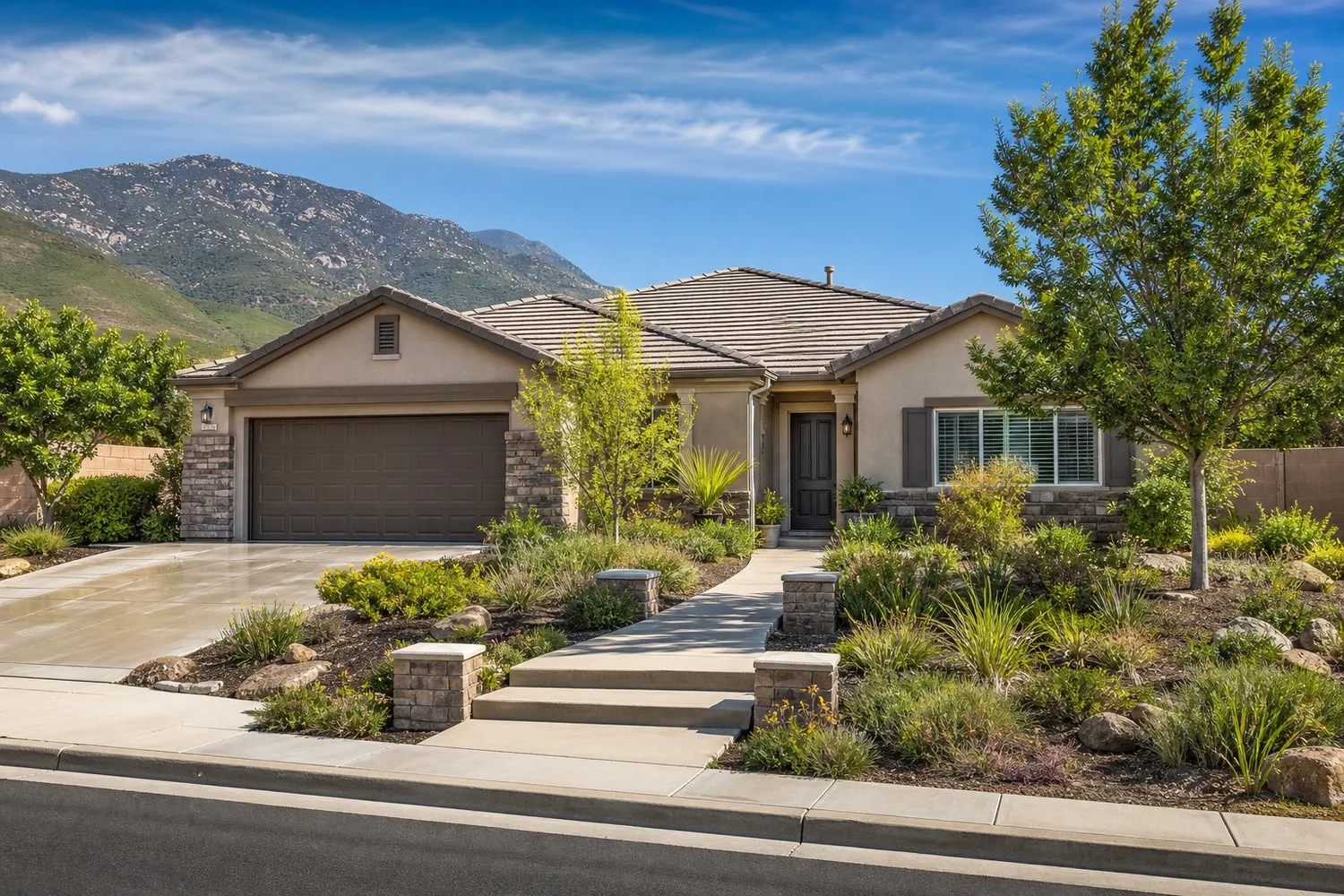
Somebody is relocating, or upsizing, or moving in together, and the question lands the same way every time: we could just rent the old place out, right?
You could. Sometimes it's the better call. But the plan almost always starts life on a napkin that reads rent minus mortgage equals profit, and that line leaves out the vacancy, the turnover, the reserves, and the tax bill that come out of the gap first.
The numbers underneath it are the whole decision, and they're specific to your house. The rent it will bring, your loan, the equity you'd leave tied up — none of that comes from a regional average.
Key takeaways
- Inland Empire apartment asking rent was $2,035 a month in the second quarter of 2026, up 0.7% over the year, while the metro's median one-bedroom rent fell from $2,038 in 2025 to $1,959 in 2026. The benchmarks disagree because they measure different things.
- Regional apartment vacancy ended the second quarter of 2026 at 5.2%, up 70 basis points year over year, so budget more time to find the right tenant than you would have two years ago.
- Submarkets move on their own: Northmarq put Fontana/Rialto asking rents at $1,937 a month in the same quarter that Southwest Riverside County sat at $2,224.
- Selling is a timeline rather than a cash-out. Riverside County's median days on market was 62 in September 2026, with escrow on top of that.
- Mortgage principal paydown builds equity but never lands in your bank account, so judge a rental on annual cash flow after operating costs first.
- The tax clock that starts the day you move out is covered in Sell or Rent Out Your House in California, and it belongs in this comparison before you sign a lease.
Putting the two columns side by side
Build two scenarios for the same property: what you'd net from a sale, and what you'd earn each year as a landlord. I've been doing this with Riverside and Inland Empire owners since 1988, and the ones who skip it are still working from that napkin.
What goes in the sell column
Start with a realistic sale price, then subtract your loan payoff and the costs of selling. I won't put a number on those costs here, because yours depend on your price, your loan, and your contract terms. A pricing strategy conversation is the first step, and a personalized net sheet is the second.
For the backdrop: the California Association of REALTORS® put the September 2026 median sold price of an existing single-family home at $620,000 in Riverside County, down 2.1% from August and 0.6% from a year earlier, and at $531,090 in San Bernardino County, up 1.7% from August and 6.2% year over year. Two counties, two directions, in the same month. FRED's Riverside County series put median days on market at 62 in September 2026, and escrow runs after that, so plan on roughly two months of marketing before a contract rather than an instant check.
If you're wondering whether this is a poor moment to sell at all, I covered that in Should You Sell in a Down Inland Empire Market?
What goes in the rent column
Start with the rent you can realistically collect, then subtract every cost of owning a rental. Separate the result into two outputs:
- Annual cash flow after vacancy, repairs, insurance, property taxes, HOA charges, management, and loan interest.
- Annual principal reduction, which raises your equity but never shows up as spendable money.
Treat appreciation as a bonus rather than a plan. Nobody can guarantee it, and a house you keep is equity you can't move into your next purchase.
What the Inland Empire rent and vacancy numbers measure
They tell you the rental market is softer and more varied than it was a couple of years ago, and not one of them is a quote for your house. Every benchmark below measures something different, and I'd rather you see that than lean on whichever number flatters the plan.
| Benchmark | Figure | What it measures | Why it isn't your rent |
|---|---|---|---|
| Apartment asking rent, Q2 2026 | $2,035 a month, up 0.7% over the year | Professionally managed apartments across both counties | Apartments, not a detached house, townhome, or condo |
| Apartment vacancy, Q2 2026 | 5.2%, up 70 basis points over the year | Multifamily vacancy across the region | Single-family rentals draw from a different pool of tenants |
| Submarket spread, Q2 2026 | Fontana/Rialto $1,937 at 5.3% vacancy; Southwest Riverside County $2,224 | Two submarkets inside the same region | Your city can sit anywhere between them |
| Metro median one-bedroom rent | $2,038 in 2025, falling to $1,959 in 2026 | One-bedroom units in the Riverside–San Bernardino metro | One-bedrooms only, not your floor plan |
The apartment figures come from Northmarq's Q2 2026 Inland Empire multifamily report. The one-bedroom series comes from San Bernardino County's Community Indicators report.
Why a softer rental market changes your vacancy math
San Bernardino County's report attributes that one-bedroom decline to increasing rental inventory and higher vacancy rates, and says the effect is showing up in move-in incentives and lower starting rent for people looking for a place. When tenants have options, owners offer concessions, wait longer for the right applicant, or take less than the first number they hoped for.
That is the part most sell-versus-rent plans get wrong. They model a full year of rent at the top of the market and no empty months at all.
Location inside the Inland Empire moves the answer
Northmarq's own submarket numbers make the point. In the second quarter of 2026, Fontana/Rialto apartment asking rents averaged $1,937 a month while Southwest Riverside County sat at $2,224, and vacancy ran 5.3% in Fontana/Rialto against 5.7% in Rancho Cucamonga. Those are four data points in a region spanning two counties and dozens of cities.
I don't have a verified vacancy rate for your street, so I pull nearby rentals that match your house on bedroom count, parking, yard, age, and condition. Those comparable listings, not an apartment average, are what a rent estimate should rest on.
What being a landlord costs besides the mortgage
It costs vacancy, repairs, insurance, taxes, possibly a manager, and your own time. Here's how I walk owners through each category, and which ones need your real numbers instead of a rule of thumb.
Vacancy and turnover
Every tenant change means days or weeks without rent, plus cleaning, paint, repairs, and leasing time. I won't hand you a universal vacancy percentage for Inland Empire houses, because nobody has published a verified one that covers every city and property type. Model your own: how many empty months can you absorb before the rental stops making sense?
Repairs, reserves, and the big-ticket items
A roof, an HVAC system, or a water heater doesn't care that rents are soft this quarter. Look at the age of each major system in the house and decide whether you'd fund a replacement out of rental income or out of your pocket. That one question ends a lot of let's-just-rent-it plans.
Insurance, property taxes, and HOA charges
A landlord policy is not what you carry on the house today, so call your insurance agent before the first tenant moves in. Then add property taxes and any HOA dues to the operating side of the model. Don't skip a line because you've stopped noticing it on your own bills.
Whether a property manager earns the fee
Often yes, if your time or your distance is the constraint. Self-managing means advertising, screening applicants, lease paperwork, repair coordination, rent collection, inspections, and keeping up with local compliance requirements. The fee is only part of the comparison. The rest is the after-hours calls, the turnover coordination, and the work of finding reliable licensed vendors. I went through that trade off in detail in Is a Property Manager Worth the Fee? Management fees are set by agreement, so get quotes in writing and compare what each one includes.
The tax and legal side, before you sign a lease
Rental income and expenses are reported under federal and California tax law, and your result depends on your own facts: depreciation, passive-activity rules, personal use, any refinancing, and eventually the sale. Gross rent minus the mortgage is neither your taxable income from the property nor what you keep once the tax is paid.
Moving out and renting also changes how a later sale is taxed, and the clock on that starts the day you leave. I laid out the federal primary-residence rules and the depreciation recapture problem in Sell or Rent Out Your House in California — read that one before you commit, and take it to your CPA with your real basis. I'm a broker, not a tax advisor, so I build the real estate side of the model and your CPA confirms the tax side.
California's landlord obligations attach the day the tenant moves in, and there's no grace period for someone doing it the first time. Security deposit limits, notice periods, habitability, and the written-notice requirement that AB 1482's single-family exemption depends on are all covered in Accidental Landlord: California Rules. Licensing and inspection programs can vary by city, so check the rules where the property sits before you list it for rent.
If you're underwater and weighing a short sale against renting, start with Selling Your Inland Empire Home for Less Than You Owe.
How to decide
Run both columns with real numbers, then ask three questions. Does the rental produce positive cash flow after a realistic vacancy cushion? Can you cover a major repair without stress? Is the equity locked up in this house worth more here than it would be in your next move?
If the answer to any of those is no, selling usually wins. If all three are yes, renting can be a sensible long-term hold, and the numbers will show it. Either way you'll know why you chose it, which is more than the napkin gives you.
If you're also weighing where you'd live next, which Inland Empire neighborhood fits your life is worth reading before you decide whether the old house stays or goes.
Common questions
Can Inland Empire rent cover my mortgage, property taxes, insurance, and repairs?
Sometimes, but only your property's numbers answer it. Regional apartment vacancy was up 70 basis points year over year in the second quarter of 2026, and the metro's median one-bedroom rent fell between 2025 and 2026, so the cushion between rent and total carrying costs may be thinner than you expect. Run the full list of costs, including empty months and reserves for major repairs, not just the loan payment.
What rent could I realistically charge for my Riverside or San Bernardino County home?
The realistic rent is what comparable homes nearby are leasing for, not a metro median or an apartment average. Match bedrooms, parking, yard, age, and condition, and treat asking rents as a starting point, since concessions are part of this market. I can pull those comparables for your address.
How much vacancy should I expect when renting out my Inland Empire home?
There's no published figure for single-family houses, so model your own. For scale, Northmarq put regional apartment vacancy at 5.2% at the end of the second quarter of 2026, with Fontana/Rialto at 5.3% and Rancho Cucamonga at 5.7%, and those are multifamily figures. Build in time for turnover, make-ready work, and leasing, then test whether the rental still works if the house sits empty longer than planned.
Is hiring a property manager worth it for an Inland Empire rental?
It's worth it when the cost of your time, your distance, or your stress is higher than the fee. A manager handles marketing, screening, lease administration, rent collection, repairs, and inspections. Get fees and services in writing from a few companies and put the fee into your cash-flow model before deciding.
What happens to my taxes if I move out and rent my former California home?
Your tax picture changes, and the details depend on your basis, your depreciation, how long you lived there, and when you later sell. Renting before you sell can also change your capital-gains result. Talk to a CPA before you move out and before you sign a lease, because I can model the real estate side but the tax answer has to come from your tax advisor.
The bottom line
Selling gives you certainty and cash. Renting gives you income and ongoing equity, along with vacancy, repairs, taxes, and a second job. The right choice comes out of your property's own numbers, so let's run them together — sale proceeds against holding returns, with the empty months and the reserves in the model instead of left off it.
If selling is the direction you're leaning, my seller's guide covers what to expect from pricing through closing.
Sources
- https://www.northmarq.com/sites/default/files/docs/NMMarketInsights-Q22026-Inland-Empire.pdf— checked 2026-11-11
- https://indicators.sbcounty.gov/housing/rental-affordability/— checked 2026-11-11
- https://www.car.org/marketdata/data/countysalesactivity— checked 2026-11-11
- https://fred.stlouisfed.org/series/MEDDAYONMAR6065— checked 2026-11-11

Jeff Maas
Broker-Owner · DRE #00981576 · NMLS #246684
Jeff Maas founded National Realty Group in 1991 and remains its Owner and Broker, and has owned National One Mortgage Corp since 1994, putting real estate, lending, escrow and property management under one roof. He has testified at trial as an expert witness in mortgage lending disputes, retained by both plaintiffs and defendants, and since 2018 has been an adjunct professor at California Baptist University teaching Real Estate Principles and Real Estate Finance. Licensed in California since 1988, he has handled well over a thousand sales and loans, with particular depth in short sales and VA financing. He is a member of the California and National Associations of REALTORS®, and a recipient of National Realty Group's Eagle Award for 2003, 2004 and 2005 and United Wholesale Mortgage's 1% Award for 2021.
More from Jeff →This post is general information, not legal, tax, lending or investment advice, and it is not a guarantee of any result. Market figures are accurate as of the date shown and change. National Realty Group is an Equal Housing Opportunity brokerage.