
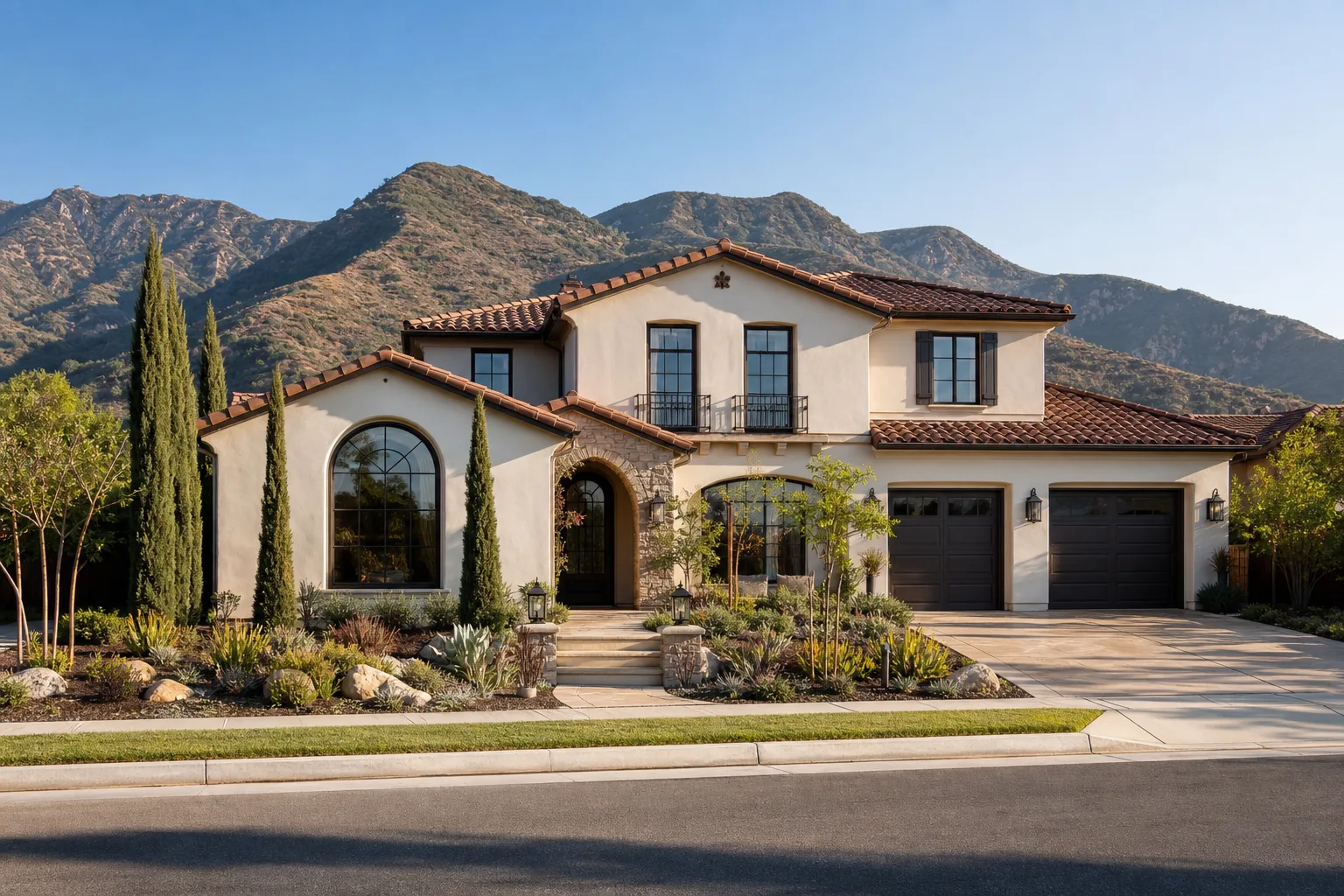
Which Inland Empire neighborhood actually fits your lifestyle?
The Inland Empire is not one place, it's a 27,000-square-mile region with communities ranging from walkable urban cores to quiet cul-de-sacs backed up against the foothills. As of September 2026, Riverside County's median sale price sits around $642,000 and San Bernardino County's around $498,000, according to mid-2026 market data. The right neighborhood depends on your commute, your budget, and how you actually want to spend your time at home, and those three things rarely point to the same ZIP code.
Key takeaways
- Riverside County's June 2026 median sale price was $642,000 with 31 days on market; San Bernardino County came in at $498,000 with 36 days on market.
- Corona's March 2026 median was $742,000, the highest among the cities profiled here, reflecting its strong freeway access to Orange County job centers.
- The Inland Empire carried roughly 1.6 months of inventory region-wide in mid-2026, well below the 4-6 months that defines a balanced market, so competition remains real in sought-after corridors.
- Buyers migrating from Los Angeles and Orange County are a major driver of Riverside County price growth, a pattern that mid-2026 market commentary confirms is still active.
- Renting first is a viable strategy: 1,412 apartment units were delivered through June 2026 with 6,253 more underway, concentrated near transit corridors in Riverside, San Bernardino, Corona, and the Rancho Cucamonga/Ontario corridor.
How do Riverside County and San Bernardino County compare for lifestyle and price in 2026?
These two counties share a border but feel noticeably different on the ground. Riverside County skews toward suburban commuter living, master-planned neighborhoods, larger lots, and price points shaped by steady migration from the coast. San Bernardino County tends to offer more entry-level and mid-range options with equally good freeway access.
Here's a quick snapshot of city-level context based on the most recent data available:
| City / Area | County | Median Sale Price (Most Recent Data) | Days on Market |
|---|---|---|---|
| Riverside County (overall) | Riverside | $642,000 (June 2026) | 31 |
| San Bernardino County (overall) | San Bernardino | $498,000 (June 2026) | 36 |
| Corona | Riverside | $742,000 (March 2026) | 58 |
| City of Riverside | Riverside | $655,000 (March 2026) | 62 |
According to HomeBuyingInstitute.com's May 2026 Inland Empire real estate summary, median home values in both Riverside and San Bernardino counties declined roughly 1.5% between May 2025 and May 2026, a modest softening, though prices remain well above pre-pandemic baselines. That's a useful data point, but it describes a trailing 12-month window that closed in May 2026. What I'm seeing on the ground heading into fall 2026 is that well-priced homes in desirable corridors are still moving fast.
The broader regional picture from Homes.com's July 2026 Inland Empire Housing Market Report shows 3,744 homes sold in the region that month, up 0.9% month-over-month. That's not a runaway market, but it's steady, and it tells me buyers are still active heading into the fall window.
What does the inventory picture mean for your neighborhood search?
With roughly 1.6 months of supply region-wide, compared to the 4-6 months that defines a balanced market, the Inland Empire still favors sellers in competitive corridors. But it's not 2021. NAR's ongoing market research shows that rising days on market nationally often signals a gradual shift in negotiating leverage, and the Inland Empire's 59-day typical time on market in June 2026 (versus 53 days nationally) suggests buyers have a bit more room to breathe than they did two years ago.
Highly sought-after neighborhoods, close-in commuter corridors, newer master-planned communities, still see multiple offers. More rural or fringe areas give you more time and more options. Your specific situation depends on where you're looking and what you're willing to trade off. That's exactly the kind of analysis I walk my clients through before we ever set foot in a home.
Which Inland Empire communities fit which lifestyle?
Corona: Commuter access with suburban polish
Corona is the choice for buyers who need reliable freeway access to Orange County or Los Angeles and don't want to sacrifice amenities. Its March 2026 median of $742,000 reflects that premium, you're paying for location as much as square footage. The retail base is strong, the neighborhoods are established, and the commute math works for a lot of people crossing the county line for work.
I've worked with plenty of buyers who came to me with an Orange County job offer and a budget that couldn't touch Irvine or Anaheim Hills. Corona is usually where that conversation ends up. It's not a compromise, it's a deliberate trade.
City of Riverside: Urban texture and historic character
Riverside sits at a median of $655,000 as of March 2026, a step below Corona, and it offers something different: a genuine downtown, the influence of UC Riverside on the cultural and economic fabric, and a mix of historic craftsman neighborhoods alongside newer residential pockets. If you want walkable blocks, local restaurants, and a sense of place that doesn't feel like every other suburb, Riverside has it.
The Riverside County Clerk-Recorder sets the county documentary transfer tax at $0.55 per $500 of property value, excluding liens, under the county's transfer tax ordinance. Inside the City of Riverside the city levies its own $1.10 per $500 on top of that, and because Riverside is a charter city the two stack rather than offset, so a transfer inside the city line carries $3.30 per $1,000 of value against $1.10 per $1,000 across most of the rest of the county. Who ultimately pays that tax is negotiable between buyer and seller in the purchase contract, confirm how it's allocated in your specific deal. I flag this not to turn a neighborhood guide into a tax explainer, but because it's a real line item worth knowing about when you're comparing cities. For a personalized breakdown of what closing costs look like on a specific property, that's a conversation to have directly with me and your escrow officer.
The California documentary transfer tax framework applies statewide at deed recording, with county and city schedules layered on top, Riverside is one of the California cities with its own additional rate.
Murrieta and Temecula: Quieter, more space, still connected
If your lifestyle leans toward newer construction, larger lots, cul-de-sacs, and weekend access to wine country and outdoor recreation, Murrieta and Temecula are consistently the answer. Mid-2026 market commentary I've reviewed frames these cities as offering some of the best value for buyers relocating from Orange County, the lifestyle is similar, the price is meaningfully lower, and the freeway access is real.
The trade-off is commute time. If your job is in Irvine or downtown LA, you're adding miles. But for remote workers, hybrid schedules, or buyers who work regionally within the IE, this part of southern Riverside County is hard to beat for what you get per dollar. According to Northmarq's Q1 2026 Inland Empire multifamily report, investor confidence in the region is rising again after a quieter 2024-2025 period, a signal that long-term demand for these communities remains strong.
San Bernardino County submarkets: Value with freeway reach
With a June 2026 county median of $498,000, San Bernardino County is one of the more accessible single-family markets left in Southern California. Cities along the 10, 15, and 210 freeway corridors, including Ontario, Rancho Cucamonga, Fontana, and Redlands, offer a wide range of neighborhoods at price points that still make sense for first-time buyers and move-up buyers alike.
The Yardi Matrix March 2026 Inland Empire multifamily report (updated September 2026) shows 1,412 apartment units delivered through June 2026 with 6,253 more underway, and new starts down over 90% year-over-year. That pipeline is concentrated near employment hubs and transit corridors, which means if you want to rent in a specific submarket before committing to a purchase, the Rancho Cucamonga/Ontario corridor and central San Bernardino have the most options right now.
Renting first is a legitimate strategy. I've had clients do a six-month lease in a neighborhood they thought they wanted, only to discover they preferred the next city over. The multifamily inventory in San Bernardino County gives you that option in a way that some tighter markets don't.
The U.S. Census Bureau's American Community Survey and the California Association of REALTORS® market data center are both worth bookmarking if you want to dig into community-level data as you narrow your search.
Common questions
Which Inland Empire neighborhoods offer walkable, urban-style living at lower prices than LA?
The City of Riverside is your strongest option for urban texture in the IE, a walkable downtown, local dining, and a university-influenced culture, at a March 2026 median of $655,000 versus well over $900,000 in most comparable LA neighborhoods. Ontario and Rancho Cucamonga also have urbanizing corridors with newer mixed-use development. None of these are Manhattan, but if you want a real downtown experience without the coastal price tag, Riverside is the most developed version of that in the region.
How do home prices in Riverside and Corona compare to other Inland Empire cities in 2026?
Corona came in at a March 2026 median of $742,000, the highest of the cities with available city-level data, driven largely by its proximity to Orange County employment. The City of Riverside was $655,000 in the same period. Both sit above the Riverside County overall median of $642,000 (June 2026) and well above San Bernardino County's $498,000 median. Cities further east or north in San Bernardino County generally offer lower entry points, though specific prices vary significantly by neighborhood and property type.
Is the Inland Empire still a seller's market, or are buyers getting more negotiating power?
It's still seller-leaning, roughly 1.6 months of inventory region-wide is well below balanced-market territory. That said, days on market have stretched to around 59 days in June 2026, and there's been modest softening in median prices over the trailing 12 months through May 2026. Buyers have more room to negotiate than they did two years ago, especially in higher-price-point cities like Corona where homes are sitting longer. In the most competitive corridors, multiple offers still happen. Your leverage depends heavily on the specific neighborhood and price range.
What's the difference between living in Riverside County vs. San Bernardino County for lifestyle and housing costs?
Riverside County generally offers more polished suburban infrastructure, stronger coastal-commuter access (especially via Corona), and higher median prices, $642,000 county-wide in June 2026. San Bernardino County tends to be more affordable at $498,000 county-wide, with a wider range of community types from urban infill to mountain-adjacent towns. The lifestyle trade-off is real: Riverside County communities often feel more finished and amenity-rich, while San Bernardino County offers more value per square foot and geographic variety. Both counties are car-centric by design, so commute planning matters regardless of which side of the county line you land on.
How does the Inland Empire rental and multifamily market look in 2026 for people who want to rent before buying?
The rental market is active but moderating. According to Yardi Matrix's 2026 Inland Empire multifamily report, 1,412 units were delivered through June 2026 with 6,253 more underway, even as new starts dropped over 90% year-over-year, meaning supply is still growing but the pipeline will thin out. Riverside, San Bernardino, Corona, and the Rancho Cucamonga/Ontario corridor have the most rental inventory, making them the best places to "test" a neighborhood before committing to a purchase. Northmarq's Q1 2026 report noted the strongest first-quarter investment pace since 2023, which suggests landlords and investors see long-term demand holding.
The bottom line on finding your fit in the Inland Empire
The Inland Empire gives you more real choices than almost any other Southern California region, urban character in Riverside, commuter convenience in Corona, semi-rural quiet in Temecula and Murrieta, and genuine affordability in San Bernardino County. The right answer depends on your commute, your budget, and what you actually want your daily life to feel like.
I've been placing buyers and sellers across this region for 38 years, and the question I always start with is the same: what does a good Tuesday look like for you? Once I know that, the neighborhood usually becomes obvious. If you're ready to figure out where you fit, reach out and let's talk through it, no pressure, just a real conversation about what the market looks like for your situation right now.
If you're starting the search, our [guide for buyers](/buyers) walks through how the process runs here. If a move means selling first, start on the [sellers page](/sellers) or get a read on your current value with a [home valuation](/home-valuation).
Sources
- https://www.rivcoacr.org/RecordingRequirements— checked 2026-10-12
- http://riversidecounty-ca.elaws.us/code/coor_title4_ch4.08_sec4.08.030— checked 2026-10-12
- https://www.nar.realtor/research-and-statistics— checked 2026-10-12
- https://www.census.gov/programs-surveys/acs— checked 2026-10-12

Jeff Maas
Broker-Owner · DRE #00981576 · NMLS #246684
Jeff Maas founded National Realty Group in 1991 and remains its Owner and Broker, and has owned National One Mortgage Corp since 1994, putting real estate, lending, escrow and property management under one roof. He has testified at trial as an expert witness in mortgage lending disputes, retained by both plaintiffs and defendants, and since 2018 has been an adjunct professor at California Baptist University teaching Real Estate Principles and Real Estate Finance. Licensed in California since 1988, he has handled well over a thousand sales and loans, with particular depth in short sales and VA financing. He is a member of the California and National Associations of REALTORS®, and a recipient of National Realty Group's Eagle Award for 2003, 2004 and 2005 and United Wholesale Mortgage's 1% Award for 2021.
More from Jeff →This post is general information, not legal, tax, lending or investment advice, and it is not a guarantee of any result. Market figures are accurate as of the date shown and change. National Realty Group is an Equal Housing Opportunity brokerage.