
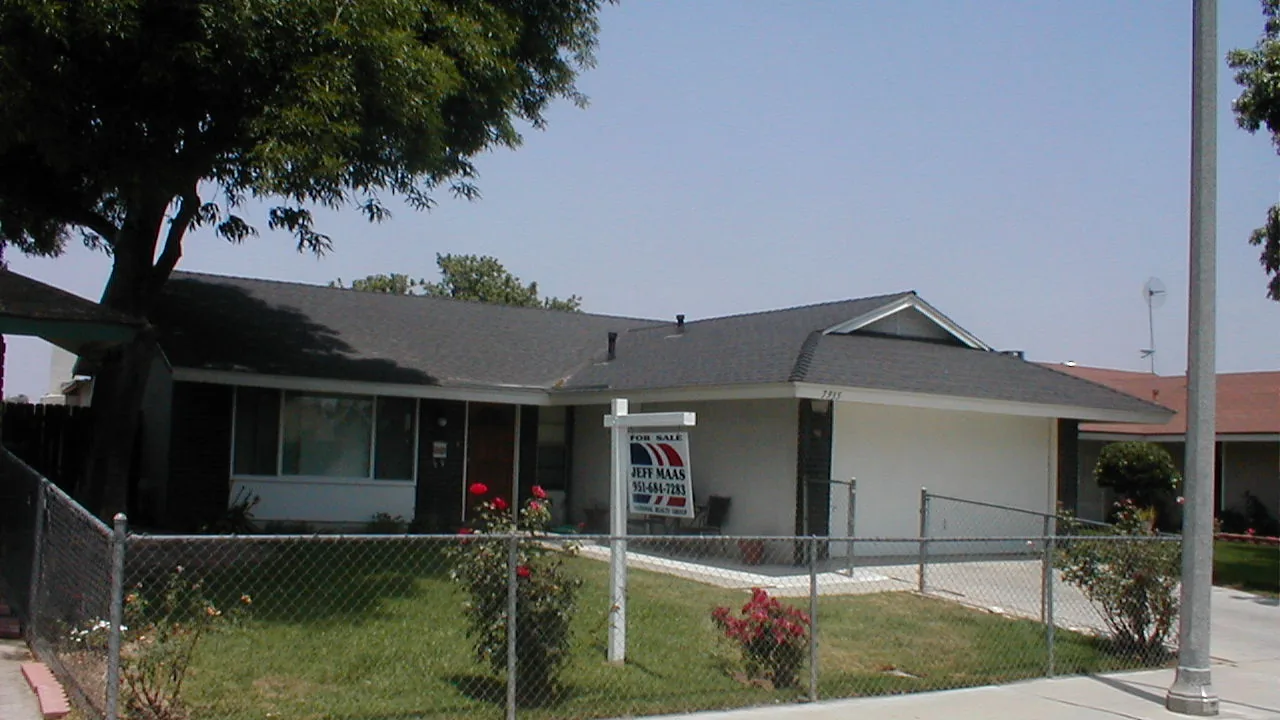
A listing agent called me last spring about two offers. Same price, same close date. One was conventional, one was VA, and she was going to recommend the conventional one.
I asked why. She said VA takes longer, the appraisals come in low, and the seller has to pay the buyer's costs.
One of those three has a grain of truth in it. The other two stopped being accurate a long time ago, and one of them was never true at all. March Air Reserve Base is twenty minutes from where we were standing, and a buyer who served lost a house on it.
Key takeaways
- VA requires no down payment as long as the sales price is at or below the appraised value, per VA's own buyer's guide. That does not mean the buyer brings nothing to closing.
- Many veterans are exempt from the funding fee entirely, including those receiving VA compensation for a service-connected disability and certain surviving spouses.
- Since 10 August 2024, VA borrowers can pay their own buyer-agent compensation. The old rule that the seller had to cover it is gone.
- VA allows sellers to pay closing costs and concessions up to 4% of the loan amount. Allows, not requires.
- The escape clause is the real difference, and it is a disclosure requirement rather than a financing weakness.
- The buyer has to occupy the home. That is the one condition agents underweight and it is the one VA takes most seriously.
Where the “no down payment” idea goes wrong
VA's buyer's guide puts it plainly: no down payment is required as long as the sales price is at or below the home's appraised value.
Read the second half of that sentence. If the contract price runs above what the VA appraiser says the home is worth, the difference has to come from somewhere, and the buyer covers it in cash. In a market where a listing gets four offers, that condition does real work.
And a buyer with no down payment still needs cash. VA's guide says the borrower must have enough to cover closing costs, prepaid items and any discount points that are their responsibility and are not financed into the loan. On a purchase, closing costs and the origination charge cannot be rolled into the loan the way they can on a VA refinance.
So the veteran is not showing up empty-handed. They are showing up without a down payment, and listing agents who treat those as the same thing are reading the file wrong.
The funding fee, and who never pays it
VA charges a funding fee on most loans. It is a percentage of the loan amount, it varies with whether this is a first or subsequent use of the benefit, and it can be financed.
What gets missed is how many borrowers owe nothing. VA's buyer's guide lists the exemptions: veterans receiving VA compensation for a service-connected disability, veterans entitled to that compensation but receiving retirement or active duty pay instead, unremarried surviving spouses of veterans who died in service or from a service-connected disability, service members with a proposed disability rating before closing, and active duty service members awarded the Purple Heart before closing.
That is not a narrow list. On a file where the buyer is exempt, the fee conversation is over before it starts, and nobody on the listing side ever finds out because nobody asks.
What the veteran can and cannot pay
This is the one that produces the most confident wrong answers.
VA publishes an itemized list of fees and charges the veteran is permitted to pay, plus a flat charge from the lender that VA caps, plus reasonable discount points. Anything outside that list is a non-allowable, and somebody other than the veteran covers it. That somebody can be the lender through a credit, the seller, or the agent.
Nobody is forced to be that somebody. VA allows sellers to pay closing costs, discount points and concessions up to 4% of the loan amount. The word in VA's own guide is allows. A seller who pays nothing has not broken a rule and has not killed the deal; the non-allowables simply shift to the lender's credit, which is how most of these close.
If the buyer's lender has structured it properly, the non-allowable question never reaches your seller. Ask them how they are handling it before you assume it does.
The 2024 change almost nobody has absorbed
For decades, a veteran using a VA loan could not pay their own buyer-agent commission. That rule shaped how every VA offer was written, and after the commission structure changed industry-wide it became a genuine problem.
VA fixed it. As of 10 August 2024, eligible veterans, active duty service members and surviving spouses using the VA home loan benefit can pay certain real estate buyer-broker fees when purchasing a home. VA's guidance on it is direct: broker fees and commissions are fully negotiable between the homebuyer and the agent, and are not set by law.
Two years on, I still hear agents repeat the old rule. Representing a veteran, you can now write a buyer-representation agreement the same way you would for anyone else, with the compensation stated in it. On the listing side, a VA offer no longer carries a structural demand that your seller fund the buyer's agent.
That was the single biggest competitive disadvantage VA buyers carried, and it is gone.
The appraisal, and the clause that actually makes people nervous
Here is the grain of truth in what that listing agent told me.
A VA-approved appraiser determines reasonable value, and the resulting notice of value includes a list of items requiring repair to meet VA's minimum property requirements. On a well-kept house that list is empty or close to it. On a flip with deferred maintenance, or a property with a roof at the end of its life, it is not.
Then there is the escape clause, which VA requires in the contract. Its wording: the purchaser shall not incur any penalty by forfeiture of earnest money or otherwise be obligated to complete the purchase of the property if the contract purchase price or cost exceeds the reasonable value.
Sellers hear that and hear risk. What it actually says is that a VA buyer cannot be forced to pay above appraised value, which is the same position a conventional buyer with an appraisal contingency is in. The difference is that VA writes it into the contract instead of leaving it to negotiation.
And a VA buyer can still agree to cover a shortfall in cash. The clause protects them from being obligated to; it does not stop them from choosing to.
Occupancy is the condition that matters
The borrower has to live in the home. VA's guide says the buyer must live in the home being bought with the loan, and when a veteran uses the benefit a second time while keeping a first property, the new home has to become the residence.
This is where a VA file genuinely differs from conventional, and it is worth knowing on the listing side because it tells you something useful: a VA buyer on your property intends to live there. In a market with investor offers that read strong on paper and fall apart on inspection, that is not nothing.
What to ask before you advise your seller
Three questions, and they take one phone call to the buyer's lender.
Is the borrower exempt from the funding fee? Often yes, and it changes the cash picture.
How are you handling non-allowable fees? A competent VA lender answers this immediately, usually with a lender credit. A lender who has to go find out is telling you something.
Has the appraisal been ordered, and what is the current turn time in this county? Turn times move. An answer from 2021 is not an answer.
If the lender handles all three cleanly, you have a buyer with a government guaranty behind the loan, a required occupancy, and no down payment obligation holding up the file. That is a strong offer, and advising against it on reflex costs your seller money.
Common questions
Do VA loans really take longer to close?
Not inherently. The timeline is driven by appraisal turn time and lender responsiveness, both of which vary by lender and by county rather than by loan type. A VA file with a lender who does them routinely closes on a normal schedule. A VA file with a lender doing their second one ever does not, and that is true of every program.
Can a seller refuse to accept a VA offer?
A seller can weigh offers on their merits, but refusing one solely because of the financing type is worth thinking carefully about, and declining to sell to someone because of their military or veteran status raises fair housing questions in several jurisdictions. The practical answer is that most refusals are based on beliefs about VA loans that are no longer accurate, which makes them expensive as well as questionable.
What happens if the VA appraisal comes in below the contract price?
The same thing that happens on any loan: the gap has to be covered or the price renegotiated. The escape clause means the buyer cannot be obligated to proceed at the higher price, but it does not prevent them from choosing to cover the difference in cash. There is also a reconsideration of value process, which a lender who works with VA regularly will know how to use.
Can a veteran use the benefit more than once?
Yes, including while still holding a property bought with a prior VA loan, though entitlement math and a down payment can come into play in that situation, and the new home has to become the residence. This is specific enough to your service record and current loans that it needs a lender who can pull your entitlement and tell you where you actually stand.
If you are a veteran buying here
March Air Reserve Base, Norco, and the retired military population across Riverside County mean a lot of these transactions happen in this market, and they go smoothly when the listing side understands the file. If you want to know where you stand before you write, start with the [financing side](/financing) and we will pull your entitlement first rather than last.
If you are an agent with a VA buyer and the listing side is pushing back, call me. Half of these are solved in one conversation with the right facts. The [buyer resources](/buyers) cover the rest of the sequence.
Sources
- https://www.benefits.va.gov/homeloans/documents/docs/VA_Buyers_Guide.pdf— checked 2026-09-29
- https://news.va.gov/134310/what-real-estate-industry-changes-mean-for-va-home-loan-borrowers/— checked 2026-09-29
- https://www.benefits.va.gov/HOMELOANS/documents/circulars/26-24-14-change1.pdf— checked 2026-09-29
- https://www.va.gov/housing-assistance/home-loans/funding-fee-and-closing-costs/— checked 2026-09-29

Jeff Maas
Broker-Owner · DRE #00981576 · NMLS #246684
Jeff Maas founded National Realty Group in 1991 and remains its Owner and Broker, and has owned National One Mortgage Corp since 1994, putting real estate, lending, escrow and property management under one roof. He has testified at trial as an expert witness in mortgage lending disputes, retained by both plaintiffs and defendants, and since 2018 has been an adjunct professor at California Baptist University teaching Real Estate Principles and Real Estate Finance. Licensed in California since 1988, he has handled well over a thousand sales and loans, with particular depth in short sales and VA financing. He is a member of the California and National Associations of REALTORS®, and a recipient of National Realty Group's Eagle Award for 2003, 2004 and 2005 and United Wholesale Mortgage's 1% Award for 2021.
More from Jeff →This post is general information, not legal, tax, lending or investment advice, and it is not a guarantee of any result. Market figures are accurate as of the date shown and change. National Realty Group is an Equal Housing Opportunity brokerage.