
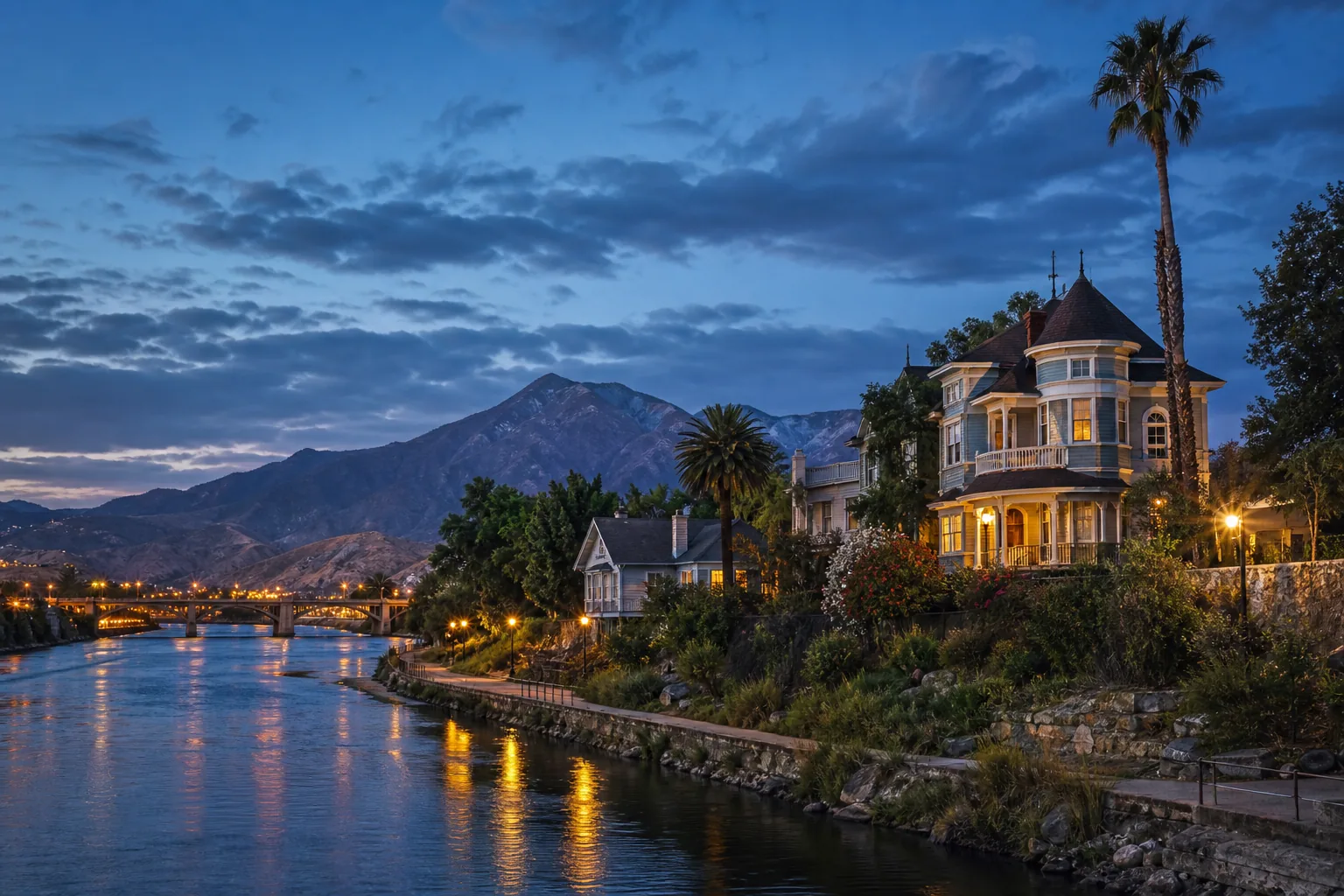
What makes Riverside's historic homes architecturally significant?
Riverside has three formally recognized historic districts, Heritage Square, Wood Streets, and the Old Magnolia Avenue Neighborhood Conservation Area, each with a distinct concentration of residential styles built between the 1880s and 1940s. The city's citrus boom and early railroad expansion attracted architects and affluent residents who commissioned high-style Victorian, Mission Revival, Craftsman, and Spanish Colonial Revival homes that still define the streetscape today. No other city in the Inland Empire has this density of recognized historic residential architecture in one place.
Key takeaways
- The City of Riverside formally recognizes Heritage Square, Wood Streets, and Old Magnolia Avenue as historic districts or neighborhood conservation areas with protected residential architectural character.
- Wood Streets spans almost a square mile and contains homes built between 1916 and 1940, making it one of the largest contiguous concentrations of early-20th-century housing in the Inland Empire.
- Heritage Square near downtown features the broadest style range in the city, French Second Empire, Victorian Stick, Craftsman, Mediterranean, Spanish Colonial Revival, Pueblo Revival, and Mission Revival homes, sometimes on the same block.
- Riverside's connection to Mission Revival architecture is anchored by the Mission Inn and continues to shape buyer interest in stucco, red-tile-roof homes that echo early California mission aesthetics.
- Buying a historic home here follows standard California escrow procedure, the documentary transfer tax applies to all property transfers in Riverside County, not just historic ones, and who pays what portion is negotiable between the parties.
Which Riverside neighborhoods have the strongest historic character?
This is the question I get most often from buyers who've driven through Riverside and noticed that the older parts of the city feel genuinely different from newer Inland Empire suburbs. The answer comes down to three distinct areas, each with its own personality.
Heritage Square: the widest style range in one place
Heritage Square sits near downtown and gives you the broadest architectural cross-section of any district in the city. According to the City of Riverside's Historic Districts and Neighborhood Conservation Area List, the district contains "a large variety of residential architectural styles popular in southern California from the 1880s to the 1920s", French Second Empire, Victorian Stick, Bungalow, Craftsman, Mediterranean, Spanish Colonial Revival, Pueblo Revival, and Mission Revival homes, often on the same blocks.
The urban feel here is more compact. You'll find smaller hipped-roof cottages alongside larger Shingle and Victorian-influenced houses, all within walking distance of civic buildings and the Mission Inn corridor. If you want the full sweep of Riverside's residential history in one neighborhood, Heritage Square is where I start every historic-buyer tour.
Wood Streets: the largest historic district and the bungalow heartland
Wood Streets is the district most longtime Riverside residents think of first when you say "historic neighborhood." It covers almost a square mile, with homes built roughly between 1916 and 1940, bounded by Beechwood Place, Magnolia Avenue, and Ramona Drive. That build window means you're looking at Riverside's second residential growth wave, driven by the same citrus-era prosperity that shaped the city's early character.
The dominant styles here are Craftsman bungalows, California Bungalows, Spanish Colonial Revival cottages, Tudor Revival, Colonial Revival, and Norman Revival homes. Tree-lined streets, wide front porches, original built-in cabinetry, and intact woodwork are common. For buyers who want a large inventory of character homes in one contiguous area, rather than scattered finds across the city, Wood Streets is the most practical starting point.
Old Magnolia Avenue: quieter, high-integrity bungalows
The Old Magnolia Avenue Neighborhood Conservation Area is more residential and quieter in feel than Heritage Square. The City of Riverside describes it as predominantly Bungalow, Craftsman, and Mediterranean houses that have maintained high architectural integrity. Buyers who want period charm without the downtown adjacency often gravitate here.
What should you actually look for when touring historic Riverside homes?
Knowing the district is one thing. Walking through a home and reading what's original versus what's been changed takes a different kind of attention. Here's how I coach buyers before we step inside.
Craftsman and bungalow homes
Per the City of Riverside's Rehab Riverside Right preservation guidance, Craftsman and bungalow homes in Riverside are typically one to one-and-a-half stories with low-pitched gable roofs, wide eave overhangs, exposed rafter tails, grouped windows, open porches, and simple square or tapered columns. Interiors should show natural wood trim, built-in cabinetry, and often a brick fireplace.
The 1901 Craftsman residence known as Rockledge Cottage on Madison Street, cited in Riverside landmark documentation, is one of the earliest documented examples of this tradition in the city. When you're touring, look for those exposed rafter tails and the porch columns first. If they've been boxed in or replaced with wrought iron, that's worth noting in your inspection priorities.
Mission Revival homes
Mission Revival is the style most closely tied to Riverside's identity. The architectural overview of Riverside neighborhoods describes these homes as featuring smooth stucco walls, red clay tile roofs, mission-shaped dormers or parapets, overhanging eaves, arched openings, and restrained ornamentation. The Mission Inn downtown, built under owner Frank A. Miller, is the style's most prominent local anchor, and its influence spread into the surrounding residential fabric.
When touring a Mission Revival home, pay attention to the condition of the stucco and tile work. Both are durable but expensive to restore correctly if they've been neglected or patched with incompatible materials. I always flag this for buyers before we go in.
Spanish Colonial Revival and Mediterranean homes
These styles, concentrated in districts like Colony Heights and parts of the Seventh Street Historic District, share some Mission Revival DNA but add decorative ironwork, carved doors, and more elaborate tile detailing. Local historic home guides note that stucco exteriors and low-pitched tile roofs are the common thread. Look for original ironwork on windows and gates, that's often the first thing removed in updates, and it's expensive to replicate authentically.
Victorian and French Second Empire homes
These are rarer in Riverside than Craftsman or Mission Revival, but Heritage Square has examples. Historic Riverside property records connect these homes to the earliest wave of citrus-boom affluence in the 1880s and 1890s. Original wood siding, decorative millwork, and multi-pane windows are the features to check. Condition varies widely, some have been meticulously maintained, others have had vinyl siding or replacement windows added over the decades.
| Style | Primary District(s) | Approximate Era | Key Visual Features |
|---|---|---|---|
| Craftsman / California Bungalow | Wood Streets, Heritage Square, Old Magnolia Ave | 1900s–1930s | Wide porches, tapered columns, exposed rafter tails, built-ins |
| Mission Revival | Heritage Square, Palm Heights, historic core | 1890s–1920s | Stucco, red tile roof, arched openings, mission-shaped parapets |
| Spanish Colonial Revival | Colony Heights, Seventh Street District | 1910s–1930s | Stucco, decorative ironwork, carved doors, tile roofs |
| Victorian / French Second Empire | Heritage Square | 1880s–1900s | Decorative millwork, multi-pane windows, wood siding |
| Tudor / Colonial / Norman Revival | Wood Streets, Colony Heights | 1920s–1940s | Steeply pitched roofs, half-timbering, brick or stucco facades |
Your specific priorities when touring will depend on which style you're drawn to and what condition the home is in, that's the kind of walk-through coaching I do with every buyer before we write an offer.
What does buying a historic home in Riverside actually involve?
The transaction process for a historic home in Riverside follows standard California escrow procedure. An escrow officer coordinates title documents, funds, and instructions from buyer, seller, lender, and agents, the same as any other Inland Empire purchase. What can be different with older homes is the title history review. An escrow officer will coordinate any recorded restrictions tied to historic designation or prior rehabilitation agreements, and those details matter before you close.
The Riverside County Assessor-County Clerk-Recorder collects a documentary transfer tax on all property transfers in Riverside County, this applies to every home sale, not just historic ones. Per Riverside County Code §4.08.030 and the County Recorder's recording requirements, the county rate is set under California Revenue and Taxation Code section 11911, and properties within the City of Riverside carry a combined city-plus-county rate. Who pays which portion is negotiable between buyer and seller, it's not fixed by the home's historic status. Your escrow officer will confirm the exact amounts and allocation in your closing documents.
Inspections on historic homes deserve extra attention. Older electrical panels, original plumbing, and unreinforced masonry foundations are common in homes built before 1940. I always recommend buyers budget time and inspection scope accordingly, not to be scared off, but to go in with eyes open. The character that makes these homes worth buying is real. So are the maintenance considerations.
Common questions
What historic neighborhoods in Riverside have the most Craftsman and bungalow homes?
Wood Streets is the strongest concentration of Craftsman and California Bungalow homes in Riverside, with nearly a square mile of homes built between 1916 and 1940. The Old Magnolia Avenue Neighborhood Conservation Area and Heritage Square also have significant Craftsman and bungalow stock, recognized by the City of Riverside's historic district designations. If Craftsman character is your priority, Wood Streets gives you the largest inventory in one contiguous area.
Is the Wood Streets area officially a historic district, and what years were those homes built?
Yes, Wood Streets is an officially recognized historic district in Riverside, covering almost a square mile of adjacent residential subdivisions. According to the Old Riverside Foundation, the homes were built roughly between 1916 and 1940, with boundaries including Beechwood Place, Magnolia Avenue, and Ramona Drive. The district reflects Riverside's second wave of early-20th-century residential growth and includes Craftsman, Spanish Colonial Revival, Tudor Revival, and Colonial Revival homes.
What does Mission Revival architecture look like in Riverside, and why is it significant here?
Mission Revival homes in Riverside are characterized by smooth stucco walls, red clay tile roofs, arched openings, mission-shaped parapets or dormers, and overhanging eaves, a clean, warm aesthetic tied directly to early California history. Riverside is one of the style's most important local anchors because of the Mission Inn downtown, whose owner Frank A. Miller was a leading proponent of the movement, per Riverside landmark documentation. That influence spread into the surrounding residential neighborhoods and continues to shape what buyers seek in the city's historic core.
How is Heritage Square different from Wood Streets in terms of home styles?
Heritage Square near downtown offers the widest range of styles in any single Riverside district, French Second Empire, Victorian Stick, Craftsman, Mediterranean, Spanish Colonial Revival, Pueblo Revival, and Mission Revival homes, some of them on the same block, per the City of Riverside. Wood Streets, by contrast, is more stylistically cohesive: primarily Craftsman bungalows, Spanish Colonial Revival, and Tudor and Colonial Revival homes from a tighter 1916–1940 build window. Heritage Square skews earlier and more eclectic; Wood Streets skews later and more uniform in character.
Does buying a historic home in Riverside involve a special property transfer tax?
No, there is no special transfer tax for historic homes. The Riverside County documentary transfer tax applies to all taxable property conveyances in the county, historic or not, and is due when the deed is recorded. For properties within the City of Riverside, a combined city-plus-county rate applies under California Revenue and Taxation Code section 11911 and Riverside County Ordinance 516.4. Who pays which portion is negotiable between buyer and seller, confirm the allocation with your escrow officer before closing.
How does escrow work when buying an older historic home in the Inland Empire?
Escrow follows the same California process for historic homes as for any other purchase, a neutral escrow officer coordinates title documents, funds, and closing instructions from all parties. What can differ with older properties is the depth of the title history review, since some historic homes carry recorded restrictions or prior rehabilitation agreements that need to be confirmed before the deed transfers. Budget extra time for inspections on pre-1940 homes, where original electrical, plumbing, and foundation systems may need evaluation beyond a standard walkthrough.
If you're seriously considering a historic Riverside home, the only way to know what you're actually getting into is to walk it with someone who's done it before. That's exactly the kind of [guidance I provide buyers](/buyers), [reach out](/contact) and let's set up a tour.
Riverside's historic neighborhoods are genuinely one of the Inland Empire's most underappreciated assets. Whether you're drawn to a Wood Streets Craftsman bungalow, a Mission Revival home near the historic core, or a Victorian in Heritage Square, the character here is real and the inventory is concentrated enough that a focused search actually works. I've been helping buyers find homes like these in this market for 38 years, [schedule a consultation](/contact) and let's find the right one for you.
Sources
- https://aquarius.riversideca.gov/clerkdb— checked 2026-10-09
- https://www.riversideca.gov— checked 2026-10-09
- https://www.rivcoacr.org— checked 2026-10-09
Jeff Maas
Broker-Owner · DRE #00981576 · NMLS #246684
Jeff Maas founded National Realty Group in 1991 and remains its Owner and Broker, and has owned National One Mortgage Corp since 1994, putting real estate, lending, escrow and property management under one roof. He has testified at trial as an expert witness in mortgage lending disputes, retained by both plaintiffs and defendants, and since 2018 has been an adjunct professor at California Baptist University teaching Real Estate Principles and Real Estate Finance. Licensed in California since 1988, he has handled well over a thousand sales and loans, with particular depth in short sales and VA financing. He is a member of the California and National Associations of REALTORS®, and a recipient of National Realty Group's Eagle Award for 2003, 2004 and 2005 and United Wholesale Mortgage's 1% Award for 2021.
More from Jeff →This post is general information, not legal, tax, lending or investment advice, and it is not a guarantee of any result. Market figures are accurate as of the date shown and change. National Realty Group is an Equal Housing Opportunity brokerage.