
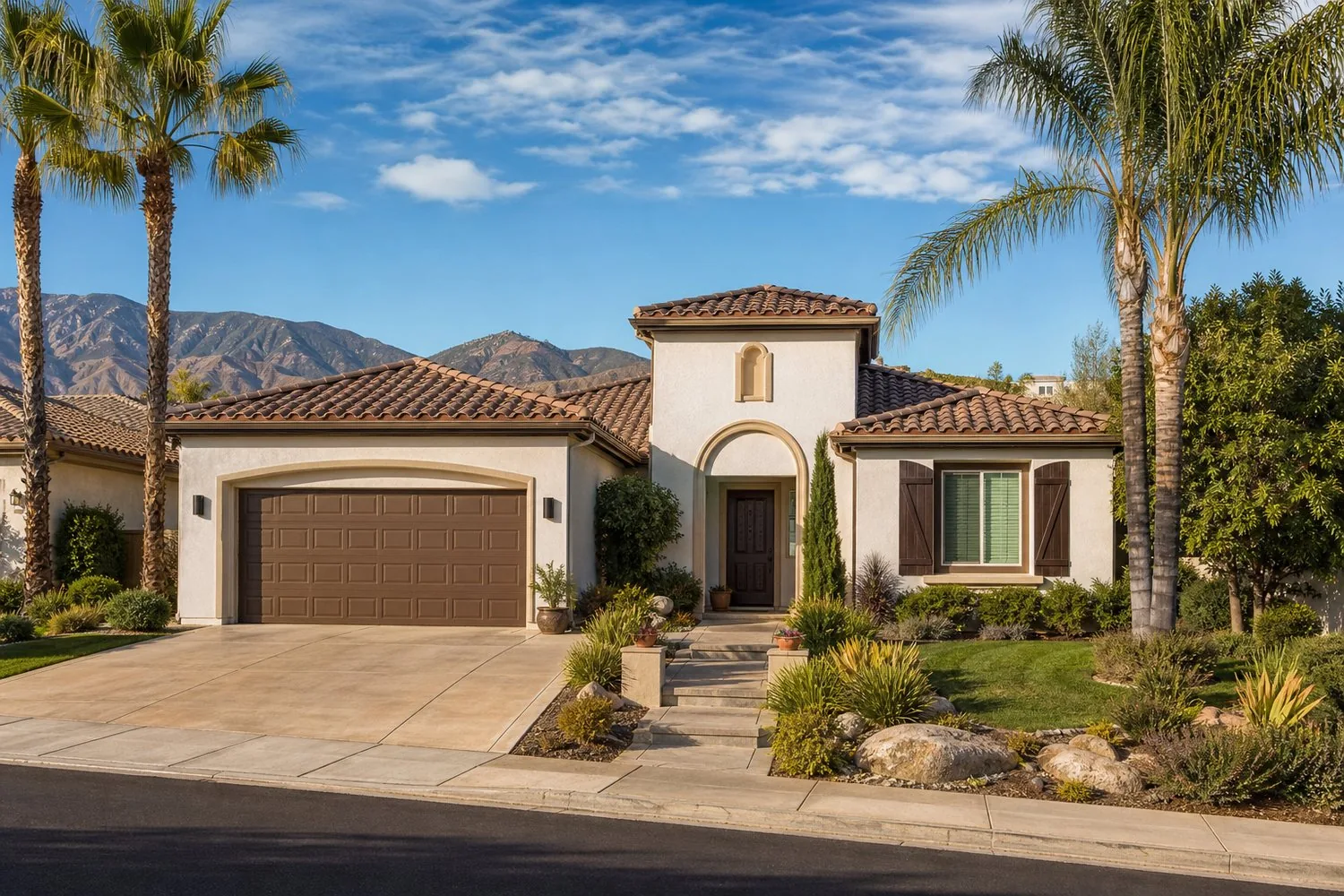
You find a house in Jurupa Valley on a Saturday, and by Monday you're asking your lender whether the county's first-time buyer program can cover part of the down payment. That's usually the week Inland Empire buyers learn how much of this depends on the county, the city limits, the property and the lender rather than on the buyer.
Three programs come up most often out here: CalHFA's MyHome Assistance Program, CalHFA's Dream For All shared appreciation loan, and Riverside County's own first-time homebuyer program. Each one is funded from a separate source, administered by different people, and one of them is closed for the year. If you want the mechanics of how California assistance is structured in general, I've written that up in [down payment assistance in California](/blog/down-payment-assistance-california-what-is-real). What follows is narrower: which of these you can use here, and where they stop.
Key takeaways
- CalHFA's MyHome is available statewide, so Riverside and San Bernardino County buyers can both look at it. CalHFA puts the assistance at up to the lesser of 3.5% of the purchase price or appraised value on its FHA loans, and 3% on its conventional loans.
- Dream For All's 2026 application window ran February 24 through March 16, 2026, and CalHFA's page now shows it closed. Treat it as a past round unless CalHFA announces another one.
- Riverside County's first-time buyer assistance is a silent second mortgage, which the county caps at the lesser of $100,000 or 20% of the purchase price, with a $1,500 minimum.
- The city of Riverside is not eligible for either of the county's published first-time buyer programs. Neither are Corona, Menifee, Perris, Palm Desert, Rancho Mirage or Calimesa, and the county's HOME guidelines exclude a longer list again.
- Riverside County also caps the price of the house itself. Its published limits top out at $564,205 for a single-family residence, which rules out a good share of what's listed in the pricier parts of both counties.
- San Bernardino County runs its own show. Confirm a current program with your city or county housing department rather than assuming Riverside County's rules carry across the line.
How the three programs compare
| Program | How it works | Published assistance | Where it applies |
|---|---|---|---|
| CalHFA MyHome | Deferred-payment junior loan toward down payment and closing costs | CalHFA: up to the lesser of 3.5% (its FHA loans) or 3% (its conventional loans) of purchase price or appraised value | Statewide, both counties |
| CalHFA Dream For All | Shared appreciation loan behind a conventional first mortgage | CalHFA: up to 20% of the purchase price, not to exceed $150,000 | Statewide, but the 2026 window closed March 16, 2026 |
| Riverside County first-time homebuyer (HOME and PLHA) | Silent second, deferred until sale, transfer or cash-out refinance | Riverside County: the lesser of $100,000 or 20% of the purchase price, $1,500 minimum | Unincorporated Riverside County and participating cities only |
CalHFA MyHome, the statewide option
MyHome is a deferred-payment junior loan that sits behind your first mortgage and goes toward the down payment, closing costs, or both. CalHFA's MyHome page sets the assistance at up to the lesser of 3.5% of the purchase price or appraised value on its FHA loans, and 3% on its conventional loans.
The conditions on that page are worth reading before you get attached to a house. You have to occupy the property as your primary residence, and non-occupant co-borrowers aren't allowed. At least one occupying first-time borrower has to finish homebuyer education, either eHome's online course or counseling through NeighborWorks America or a HUD-approved agency. And you have to fall under CalHFA's income limits for the county you're buying in.
Those limits move. CalHFA publishes them by county and updates them periodically, so the figure in a lender worksheet from last spring may not be the one that applies to you. Ask your lender which income limit table they're working from.
Dream For All is closed for 2026
CalHFA's Dream For All page says the application period is closed, and the portal shut on March 16, 2026. CalHFA's January announcement had set the window at February 24 through March 16, with applications chosen by random selection rather than first come, first served, and at least 10% of funding directed to applicants in a Qualified Census Tract. Applicants needed a preapproval letter from a CalHFA Approved Lender before they could apply, and anyone who got conditional approval had 90 days to go shopping.
It's worth understanding anyway, because it's structured unlike the others. Dream For All offered up to 20% of the purchase price, not to exceed $150,000, and when you sell, transfer the home or pay off the first mortgage you repay the original amount plus a share of the appreciation. CalHFA also required all borrowers to be first-time buyers, one borrower to be a first-generation homebuyer, and one to be a current California resident.
If a future round opens, the preapproval requirement means the preparation happens months before the window does.
Riverside County's program, and the cities it leaves out
Here's the part that catches people, and it's the reason I'd rather you read this before you tour anything.
Riverside County's first-time homebuyer assistance runs through its Housing and Workforce Solutions department, not the Economic Development Agency, and it runs on more than one funding source. The county publishes separate lender guidelines for its HOME-funded program and its PLHA-funded program. Both describe the same basic structure: a silent second, with principal and interest deferred until you sell, transfer or take cash out in a refinance. Both set the absolute maximum at $100,000 for down payment assistance or 20% of the purchase price, whichever is less, with a $1,500 minimum, and both narrow it further with a gap-financing test that targets a housing cost between 25% and 35% of income.
What the county's guidelines also do is draw a map. All unincorporated areas of Riverside County are eligible. Incorporated cities are eligible only if they're on the participating list, and the guidelines name the ones that aren't.
Under the 2025–2026 PLHA guidelines, seven cities are not eligible: Calimesa, Corona, Menifee, Palm Desert, Perris, Rancho Mirage and Riverside. Under the HOME guidelines, the ineligible list is longer still: Cathedral City, Corona, Hemet, Indio, Jurupa Valley, Lake Elsinore, Menifee, Moreno Valley, Murrieta, Palm Desert, Palm Springs, Perris, Rancho Mirage, Riverside and Temecula.
So a buyer shopping in the city of Riverside, which is where a lot of my first-time buyers start, cannot use either program on a house inside those city limits. No amount of funding or good timing changes that, because the property sits outside the program's footprint altogether. If the city matters more to you than the assistance does, my write-up on [why Riverside works for first-time buyers](/blog/first-time-home-buyers-riverside-ca) covers the market side, and the [city-by-city comparison](/blog/inland-empire-cities-for-first-time-buyers) is where to start if you're flexible about where you land.
Two other limits in those guidelines matter as much as the map. The county caps the purchase price, with published limits of $564,205 for an existing or new single-family residence, $513,000 for a condominium or townhouse, and $361,000 for a manufactured home. And the money only comes through a lender that has signed a Lender Participation Agreement with the county, so yours either participates or you'll need one that does.
County funding also runs out. Confirm in writing that money is available for your transaction before you treat it as part of your offer.
San Bernardino County is a separate question
CalHFA's programs are statewide, so a San Bernardino County buyer can look at MyHome on the same terms as anyone else. The county program belongs to Riverside County alone, and nothing about it carries across the line.
For San Bernardino County, call the city you're buying in and the county housing department, and ask what's open right now and whether it still has funds. Programs there open, pause and exhaust their allocations the same way. A blog post, a listing portal or a lender's old worksheet is not a current answer, and that includes this one six months from now.
What to do before you write an offer
Sort out the money before you fall for a house, not after.
- Check the address against the program map first. For Riverside County's program, confirm the property sits in an unincorporated area or a participating city.
- Confirm your income against the current table for the program you're using, and ask your lender which version of it they have.
- Find out whether your lender participates. CalHFA programs run through CalHFA-approved lenders, and the county's program requires a signed participation agreement.
- Finish the required homebuyer education. The county's certificates expire after a year, so timing matters.
- Get preapproved. My walk-through of the [Inland Empire mortgage process](/blog/inland-empire-mortgage-process-step-by-step) shows where this sits in the timeline.
- Get written confirmation from the administering agency or the participating lender before you count on any of it.
Common questions
What first-time buyer programs are available in Riverside and San Bernardino counties?
CalHFA's MyHome Assistance Program is available statewide, so it reaches both counties. Riverside County runs its own first-time homebuyer assistance through HOME and PLHA funding, limited to unincorporated areas and participating cities. San Bernardino County buyers should check with their own city and county housing departments rather than assuming Riverside County's program applies.
How much assistance does CalHFA's MyHome program provide?
CalHFA sets MyHome at up to the lesser of 3.5% of the purchase price or appraised value on its FHA loans, and 3% on its conventional loans. It's a deferred-payment junior loan, so the money is postponed rather than forgiven, and your lender confirms which figure applies to your loan type.
Can I qualify as a first-time buyer if I owned a home more than three years ago?
Possibly. Riverside County's published guidelines use a three-year test: you must not have owned a home in the last three years, though owning unimproved land is allowed and counts toward the program's asset limit. CalHFA publishes its own first-time buyer definition for MyHome, and the two aren't automatically identical, so have your lender confirm which test applies to the program you're using.
What does "first-generation homebuyer" mean for Dream For All?
It's an eligibility category. CalHFA required at least one borrower on a Dream For All loan to qualify as a first-generation homebuyer, and it publishes the exact definition on the Dream For All page. The application documents included parent information and proof of that relationship. Have your lender check it against your situation before you rely on it in a future round.
Can CalHFA assistance be combined with a city or county program?
Sometimes, depending on each program's rules and your lender's willingness to close with layered assistance. Don't assume stacking is allowed. Ask your lender to confirm in writing which programs can be used together on your property, and what that does to the terms of your first loan.
Before you start looking
Inland Empire first-time buyer help is real, and it's conditional on county, city limits, property, income, lender and funding. Most of those are answerable in an afternoon, and all of them are easier to answer before you've written an offer than after.
If you want to work out which programs reach the house in front of you, [start here](/buyers) and we'll map them against the address.
Sources
- https://www.calhfa.ca.gov/homebuyer/programs/myhome.htm— checked 2026-10-26
- https://www.calhfa.ca.gov/dream/— checked 2026-10-26
- https://www.calhfa.ca.gov/about/press/press-releases/2026/pr2026-01-16.htm— checked 2026-10-26
- https://www.calhfa.ca.gov/homeownership/limits/index.htm— checked 2026-10-26
- https://rivcohws.org/sites/g/files/aldnop131/files/Housing/Resources/2025-2026%20PLHA%20FTHB%20Lender%20Program%20Guidelines%20-%20090925.pdf— checked 2026-10-26
- https://rivcohws.org/sites/g/files/aldnop131/files/2024-06/2024-2025%20HOME%20FTHB%20Program%20Guidelines.pdf— checked 2026-10-26
Jeff Maas
Broker-Owner · DRE #00981576 · NMLS #246684
Jeff Maas founded National Realty Group in 1991 and remains its Owner and Broker, and has owned National One Mortgage Corp since 1994, putting real estate, lending, escrow and property management under one roof. He has testified at trial as an expert witness in mortgage lending disputes, retained by both plaintiffs and defendants, and since 2018 has been an adjunct professor at California Baptist University teaching Real Estate Principles and Real Estate Finance. Licensed in California since 1988, he has handled well over a thousand sales and loans, with particular depth in short sales and VA financing. He is a member of the California and National Associations of REALTORS®, and a recipient of National Realty Group's Eagle Award for 2003, 2004 and 2005 and United Wholesale Mortgage's 1% Award for 2021.
More from Jeff →This post is general information, not legal, tax, lending or investment advice, and it is not a guarantee of any result. Market figures are accurate as of the date shown and change. National Realty Group is an Equal Housing Opportunity brokerage.