Say you've spent two Saturdays touring houses. The first weekend was in Riverside, the second in Moreno Valley, right next door along the 60. The Moreno Valley houses were bigger for the money. The Riverside houses had more character, or a shorter drive, or a school you'd already heard of. Now you're comparing listings in two browser tabs and the numbers don't line up the way you expected.
That's the most common version of this question I hear, and it's a fair one — the answer depends on more than the list price. These are neighboring cities in the same county, but they price differently, they were built in different eras, and the monthly details (who sends the electric bill, which school district you land in, what you pay in transfer tax when you sell) aren't the same.
Here's how I'd lay the two side by side.
Key takeaways
- Redfin's data put Moreno Valley's median sale price at $547,500 in August 2026 and Riverside's at about $660,000 for the three months ending September 2026.
- On a price-per-square-foot basis, Redfin had Moreno Valley at $317 and Riverside at $378, so a 2,000-square-foot house ran roughly $120,000 less in Moreno Valley.
- Census figures for 2020 to 2024 showed a longer average commute from Moreno Valley (35.5 minutes) than from Riverside (31.3 minutes).
- The City of Riverside levies its own transfer tax on top of the county's. Moreno Valley is a general-law city, so it doesn't add that second layer when you sell.
- Both cities are split between two school districts, so check the district for the exact address, not the city name.
What the price gap looks like in 2026
Start with the number most buyers notice first.
| Moreno Valley | Riverside | |
|---|---|---|
| Median sale price (Redfin) | $547,500, August 2026 | about $660,000, three months ending September 2026 |
| Median price per square foot (Redfin) | $317 | $378 |
| Median days on market (Redfin) | 38 | 41 |
| Median owner-occupied home value (Census, 2020–2024) | $503,700 | $584,800 |
| Owner-occupied share of homes (Census, 2020–2024) | 63.3% | 56.8% |
| Average household size (Census, 2020–2024) | 3.79 people | 3.21 people |
| Mean commute to work (Census, 2020–2024) | 35.5 minutes | 31.3 minutes |
The price-per-foot line is the one I'd focus on. A median sale price mixes condos, starter homes and estates together, so it moves around with whatever happened to sell that month. Price per square foot is closer to an apples-to-apples read, and the gap there was about $61 a foot. On a 2,000-square-foot house that's around $122,000. On 2,500 square feet it's north of $150,000.
That's why the Moreno Valley houses felt bigger on your tour. They were.
Days on market were close in both cities, so neither one is a market where you can lowball and wait.
What you're buying in each city
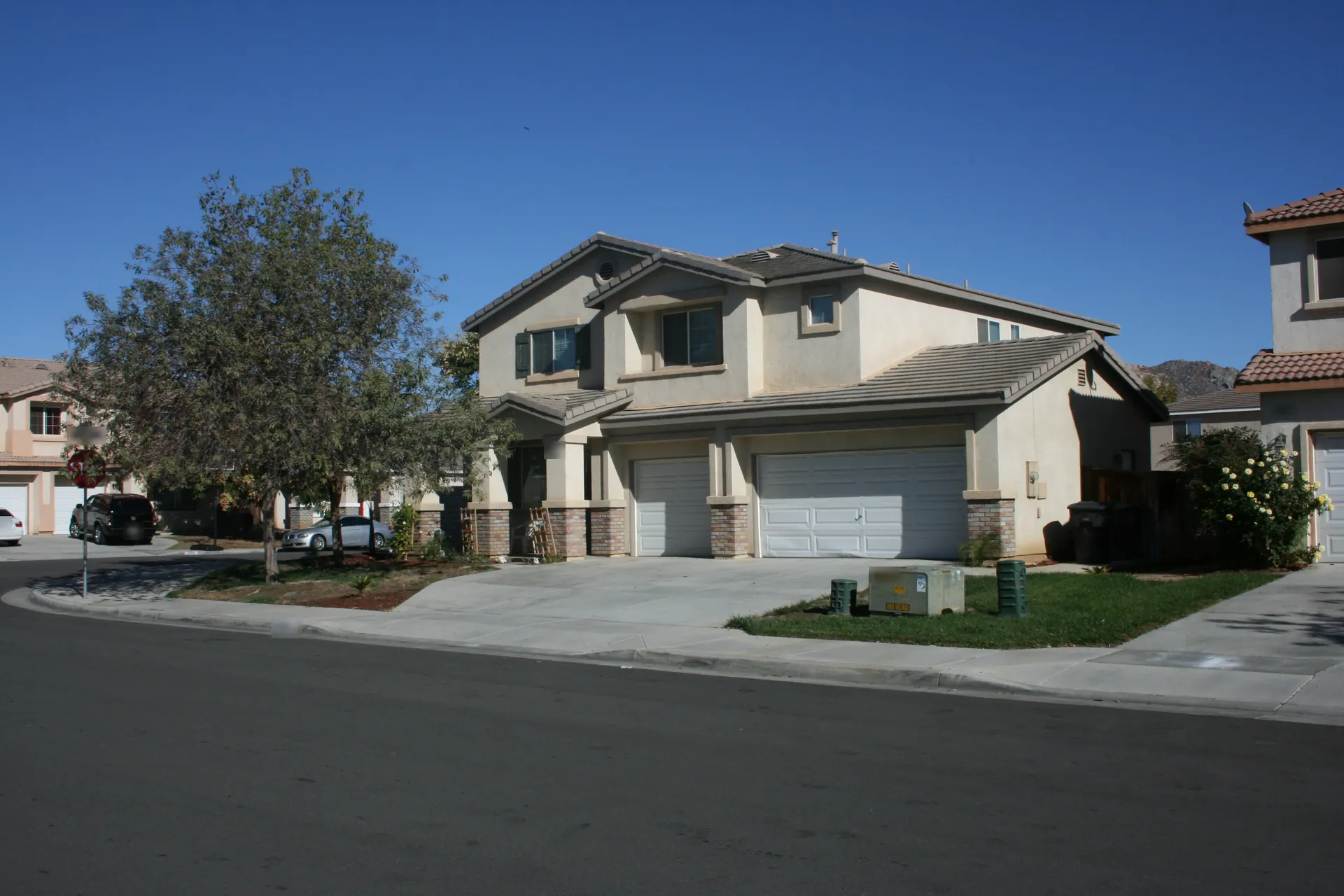
Moreno Valley is a young city. It incorporated in December 1984, when the communities of Moreno, Sunnymead and Edgemont merged into one. In my experience, most of what you'll tour there is tract housing from the last several decades: stucco, tile roofs, two stories, attached garages, and floor plans you'll start to recognize after the third showing. The photo at the top of this post is typical of what a lot of Moreno Valley streets look like.
Riverside is a much older city with a much wider range of housing. You can buy a 1920s Craftsman near downtown, a postwar ranch house in the middle of town, or a newer tract home on the edges. I wrote a separate guide to [historic homes in Riverside](/blog/historic-homes-riverside-ca-architecture-guide) because older houses come with their own questions about plumbing, electrical and permits.
What that means in practice:
- If you want space and a newer house for the money, Moreno Valley usually wins on the numbers.
- If you want an older neighborhood, mature trees and a walkable downtown, Riverside has more of that to offer.
- If you're shopping newer construction in either city, ask about Mello-Roos. Community facilities districts are common in newer Inland Empire tracts, and the annual special tax can change your monthly cost noticeably. My [Mello-Roos guide](/blog/mello-roos-inland-empire-what-a-cfd-costs) covers what the disclosure has to tell you.
Commute and getting around
The Census numbers show the average Moreno Valley worker spending about four more minutes each way than the average Riverside worker. That's an average across everyone, though, and it hides the part that matters to you: where your job is.
If you work in Riverside, Moreno Valley is a short drive west on the 60. If you work in Orange County or Los Angeles, both cities feed into the same congested corridors, and Riverside starts you a few miles closer.
Rail is an option from both. The Moreno Valley/March Field Metrolink station opened in June 2016 on the 91/Perris Valley Line, which runs through Riverside toward Los Angeles Union Station. The Riverside County Transportation Commission finished a second platform there in July 2025, a $38 million project meant to improve reliability on the line. Riverside has its own stations on the same line, including Riverside–Hunter Park/UCR.
Schools: check the address, not the city
Both cities are served by more than one school district, and that trips buyers up more often than you'd think.
- Moreno Valley is served by Moreno Valley Unified and Val Verde Unified. Val Verde's boundaries also cover parts of Perris and Mead Valley.
- Riverside is served mainly by Riverside Unified, with Alvord Unified covering the western portion of the city.
Look up the specific address with the district before you write an offer, then check the school's results on the California School Dashboard.
Utilities and the monthly bills that surprise people
Riverside has its own utility. Riverside Public Utilities is a consumer-owned electric and water utility that's been running since 1895. It serves about 112,000 electric customers and 66,000 water customers in and around the city. If you're buying inside Riverside's city limits, it's very likely your electric provider.
Moreno Valley has a smaller city-owned utility. Moreno Valley Utility started serving customers in 2004 and handles new commercial and residential development within its service area. It serves a little over 6,500 customers, while the city has more than 55,000 households, so most Moreno Valley homes buy their electricity from a different provider.
Electric rates and water rates differ between providers. During escrow, ask the seller for a recent utility bill. It tells you who the provider is and gives you a real sense of summer cooling costs, which in the Inland Empire is the number that matters.
Taxes: one difference you'll feel when you sell
Property tax works about the same way in both cities. Prop 13 sets the base at 1% of assessed value, then voter-approved bonds and special assessments stack on top. My post on [how the Riverside County property tax rate breaks down](/blog/riverside-county-property-tax-rate-how-it-breaks-down) walks through why two houses on the same street can carry different bills.
The transfer tax is where the cities split.
Riverside County charges $1.10 per $1,000 of value on a sale. The City of Riverside is a charter city and charges its own $2.20 per $1,000 on top of that. The two stack, so a seller inside Riverside's city limits pays $3.30 per $1,000 combined.
Moreno Valley incorporated as a general-law city. Under the state's transfer tax statute, a general-law city's tax is credited against the county's, so the combined rate doesn't climb above the county's $1.10.
On a $600,000 sale, Riverside's city layer adds $1,320. It's a real line on your settlement statement, and worth knowing on day one. My breakdown of [what it costs to sell a house in Riverside County](/blog/what-it-costs-to-sell-a-house-in-riverside-county) covers the rest of the seller's side.
Who tends to choose which
These are patterns I've seen over a lot of years in this market, not rules.
Moreno Valley tends to fit buyers who need more bedrooms, want a newer house without paying new-construction prices, or work east of Riverside, near March Air Reserve Base or the medical campuses the city lists, including Kaiser Permanente and Riverside University Health System.
Riverside tends to fit buyers who want an older neighborhood, a shorter drive west, proximity to UC Riverside or downtown, or a specific school. They're paying a premium per foot for location and housing variety.
Here's a hypothetical that shows the trade. Two buyers have the same budget. One wants four bedrooms and a yard for a growing family and works from home three days a week. The other wants a 1940s bungalow near downtown and commutes to Orange County daily. The first buyer will probably find more house in Moreno Valley. The second buyer will probably be happier paying more per foot in Riverside. Neither is wrong.
Common questions
Is Moreno Valley cheaper than Riverside?
On Redfin's 2026 numbers, yes. Moreno Valley's median sale price was $547,500 in August 2026, against about $660,000 in Riverside for the three months ending September 2026. Per square foot, Moreno Valley ran about $61 less.
Which city has the shorter commute?
On average, Riverside. Census data for 2020 to 2024 put Riverside's mean commute at 31.3 minutes and Moreno Valley's at 35.5. Your own commute depends on where you work, and Moreno Valley is closer to jobs on the east side of the county.
Do I pay a city transfer tax when I sell in Moreno Valley?
Not as an extra layer. Moreno Valley is a general-law city, so any city transfer tax is credited against Riverside County's $1.10 per $1,000. Inside the City of Riverside, the charter-city tax of $2.20 per $1,000 stacks on the county's.
How do I know which school district a house is in?
Look up the exact address with the district. Moreno Valley is split between Moreno Valley Unified and Val Verde Unified, and Riverside between Riverside Unified and Alvord Unified, so the city name alone won't tell you.
Deciding between the two
The fastest way to settle this is to pick three houses in each city at the same price, then drive your actual commute from each one on a weekday morning. Price per foot, school district and utility provider take ten minutes to check once you have specific addresses.
Our city pages for [Moreno Valley](/cities/moreno-valley) and [Riverside](/cities/riverside) have more on each market. If you'd like help comparing specific homes, [reach out to our team](/contact) and we'll pull the numbers on the addresses you're considering.
Sources
- https://www.census.gov/quickfacts/fact/table/morenovalleycitycalifornia/PST045225— checked 2026-10-15
- https://www.census.gov/quickfacts/fact/table/riversidecitycalifornia,morenovalleycitycalifornia/PST045225— checked 2026-10-15
- https://www.redfin.com/city/12621/CA/Moreno-Valley/housing-market— checked 2026-10-15
- https://www.redfin.com/city/15935/CA/Riverside/housing-market— checked 2026-10-15
- https://www.moval.org/community/pdfs/mvglance.pdf— checked 2026-10-15
- https://moval.gov/resident_services/schools.html— checked 2026-10-15
- https://moval.gov/mvu/about-mvu.html— checked 2026-10-15
- https://scppa.org/member-riverside— checked 2026-10-15
- https://riversideca.gov/athomeinriverside/alvord.asp— checked 2026-10-15
- https://www.rctc.org/moreno-valley-march-field-project-ribbon-cutting/— checked 2026-10-15
- https://en.wikipedia.org/wiki/Moreno_Valley/March_Field_station— checked 2026-10-15
- https://law.justia.com/codes/california/code-rtc/division-2/part-6-7/chapter-2/section-11911— checked 2026-10-15
Jeff Maas
Broker-Owner · DRE #00981576 · NMLS #246684
Jeff Maas founded National Realty Group in 1991 and remains its Owner and Broker, and has owned National One Mortgage Corp since 1994, putting real estate, lending, escrow and property management under one roof. He has testified at trial as an expert witness in mortgage lending disputes, retained by both plaintiffs and defendants, and since 2018 has been an adjunct professor at California Baptist University teaching Real Estate Principles and Real Estate Finance. Licensed in California since 1988, he has handled well over a thousand sales and loans, with particular depth in short sales and VA financing. He is a member of the California and National Associations of REALTORS®, and a recipient of National Realty Group's Eagle Award for 2003, 2004 and 2005 and United Wholesale Mortgage's 1% Award for 2021.
More from Jeff →This post is general information, not legal, tax, lending or investment advice, and it is not a guarantee of any result. Market figures are accurate as of the date shown and change. National Realty Group is an Equal Housing Opportunity brokerage.